
ENGAGING CHEMISTRY LEARNERS: THE AP MODEL’S IMPACT ON ACHIEVEMENT AND MOTIVATION
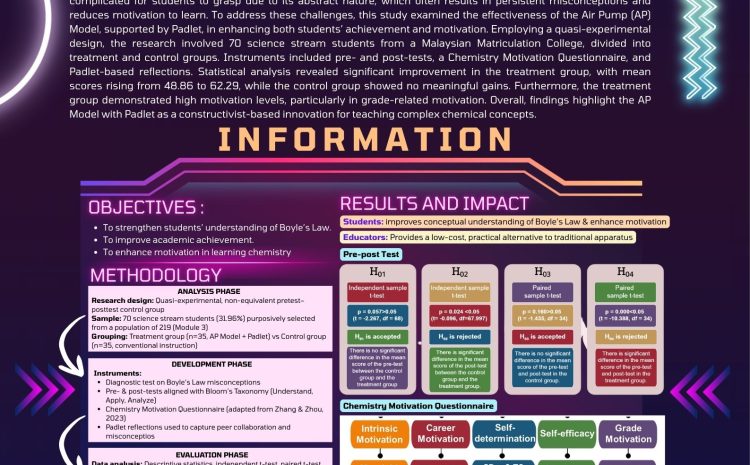
Scientific concepts such as Boyle’s Law are often challenging for students to grasp when taught using conventional methods. This limitation frequently leads to misconceptions and a decline in motivation. To overcome these issues, the Air Pump (AP) Model was introduced as an innovative teaching aid with three main objectives: (i) to strengthen students’ understanding of Boyle’s Law, (ii) to improve academic achievement, and (iii) to enhance motivation in learning chemistry. The AP Model was designed from simple, low-cost materials including plastic containers, valve, and pressure gauges, enabling a practical demonstration of Boyle’s Law in action. Its effectiveness was tested through a quasi-experimental design involving 70 Science stream students at Perak Matriculation College. The participants were divided into two groups: the treatment group, which used the AP Model, and the control group, which received conventional instruction. The results revealed significant improvement in the AP group, with mean scores increasing from 48.29 to 62.29 (p = 0.000), compared to no notable gain in the control group (p = 0.160). Motivation levels were also higher, with an average score of 4.18. In conclusion, the AP Model is proven to enhance both performance and motivation, demonstrating its potential as an effective STEM teaching innovation.
- Diamond Innovators (Professionals, academics, and industry)
- Innovation in Learning & Teaching
- INNOVATION PRODUCT (For innovators who already have innovation products to compete)
- Malaysia
- CHOW LAI KIM
- PERAK MATRICULATION COLLEGE
- LIZAWATI BINTI MOHAMAD HAM